Executive Career
Transition Advisory
Career transitions at high levels of responsibility are rarely only professional decisions.

Executive Career Transition
They are identity decisions.
They affect:
- stability,
- relationships,
- confidence,
- meaning,
- lifestyle,
- financial pressure,
- long-term sustainability,
- and the future architecture of a person’s life.
For many high-performing professionals, career transition does not happen because they suddenly become incapable.
It happens because:
- the role no longer fits,
- the cost has become unsustainable,
- the environment has changed,
- burnout has accumulated,
- priorities have evolved,
- or success itself has altered what meaningful work now looks like.
At Haltere Corporation, we provide executive career transition advisory for professionals navigating complex professional change, reinvention, leadership shifts, relocation, burnout, and high-stakes career decisions.
Our work is designed to help capable people move through transition with greater strategic clarity, psychological stability, and long-term alignment.
Not reactively.
Intentionally.
Executive Career Transitions Are Often More Complex
Than They Appear
Externally, a transition may look straightforward:
- a resignation,
- a new role,
- a relocation,
- a pivot,
- a promotion,
- or a departure from a long-standing career path.
Internally, however, many professionals are navigating:
- identity disruption,
- fear of wasted potential,
- uncertainty,
- grief,
- burnout,
- pressure from external expectations,
- decision fatigue,
- or the unsettling realization that previous definitions of success no longer feel sustainable.
High-performing professionals are often deeply skilled at maintaining outward competence during periods of internal uncertainty.
Which is why career transitions frequently become psychologically isolating.

Many Professionals Wait Too Long
People often remain in misaligned environments because:
- responsibility feels too great,
- uncertainty feels unsafe,
- identity has become fused with achievement,
- or the external markers of success make change difficult to justify.
Over time, however, chronic misalignment can quietly erode:
- clarity,
- creativity,
- motivation,
- relational presence,
- emotional resilience,
- and long-term sustainability.
The result is often prolonged over-functioning long after the internal system has begun signaling the need for recalibration.
Our Approach
Our executive career transition advisory integrates:
- strategic decision support,
- psychologically informed transition guidance,
- sustainable capacity development,
- leadership insight,
- and identity-aware career recalibration.
We help professionals:
- clarify direction,
- navigate uncertainty,
- reduce cognitive overload,
- evaluate strategic options,
- strengthen sustainable decision-making,
- and move through transition with greater coherence and confidence.
This is not generic career coaching.
Nor is it simplistic motivational guidance.
Career transitions at high levels of responsibility simultaneously involve:
- operational realities,
- psychological complexity,
- leadership identity,
- relational dynamics,
- financial considerations,
- and long-term sustainability.
Our work is designed to support the full complexity of that process.
Common Executive Career Transition Scenarios
Burnout & Reassessment
Recognizing that current patterns of performance are no longer sustainable.
Leadership Transition
Navigating shifts in authority, visibility, and professional identity.
Reinvention After Success
Reevaluating direction after achievement no longer feels fulfilling or aligned.
Career Pivot & Realignment
Exploring more sustainable, meaningful, or strategically aligned professional paths.
Relocation & International Transition
Navigating the personal and professional complexity of geographic and cultural change.
Exit & Next-Stage Planning
Clarifying what comes next after leaving a long-held role, company, or leadership structure.
Why Career Transitions Become So Difficult
Many professionals have spent years building lives around:
- competence,
- reliability,
- performance,
- responsibility,
- and external validation.
As a result, career transitions can feel psychologically destabilizing even when they are strategically necessary.
The challenge is rarely a lack of intelligence or capability.
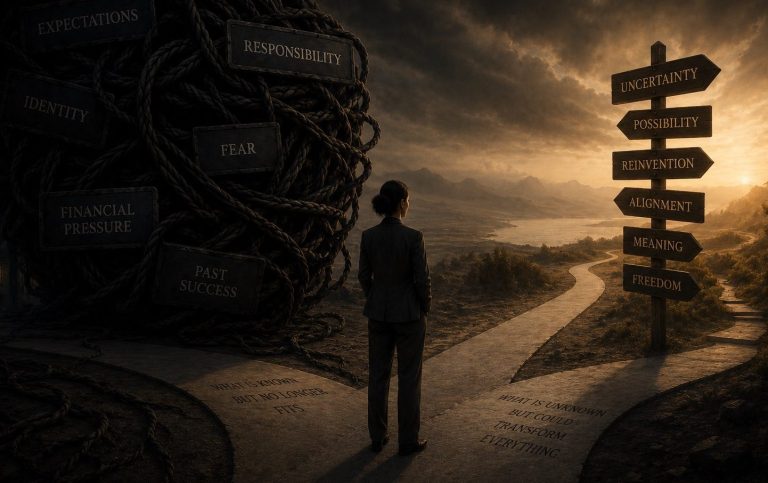
The challenge is that transitions require people to navigate uncertainty while simultaneously reevaluating:
- identity,
- safety,
- ambition,
- meaning,
- and sustainability.

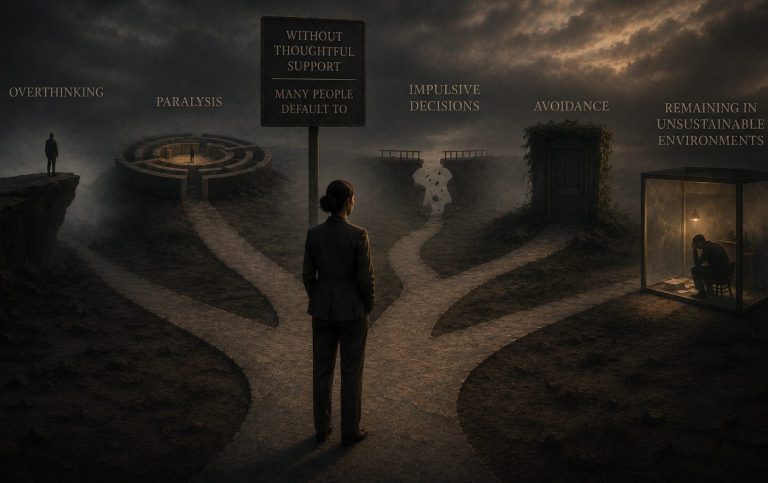
Without thoughtful support, many people default toward:
- overthinking,
- paralysis,
- impulsive decisions,
- avoidance,
- or remaining in increasingly unsustainable environments.
What Effective Career Transition Requires
Meaningful transition often requires:
- strategic clarity,
- emotional honesty,
- psychologically informed decision-making,
- sustainable pacing,
- and the ability to tolerate uncertainty without collapsing into reactivity.
It also requires the willingness to evolve.
Not because prior success was wrong —
but because people change.
Priorities change.
Capacity changes.
Meaning changes.
And eventually, leadership requires responding intentionally to those realities rather than endlessly overriding them.
What Clients Commonly Experience
Clients frequently report:
- greater clarity and confidence,
- reduced cognitive overwhelm,
- stronger alignment between values and career direction,
- improved decision-making,
- renewed motivation and creativity,
- healthier professional boundaries,
- and a more sustainable relationship with work and performance.
Not because transition becomes easy —
but because they develop a more grounded and intentional way of navigating it.
Career Transitions Shape More Than Careers
The decisions people make during periods of transition often influence:
- health,
- relationships,
- identity,
- long-term fulfillment,
- leadership effectiveness,
- and the overall sustainability of their lives.
Handled thoughtfully, career transitions can become opportunities for deeper alignment, renewed vitality, and more sustainable success.
If you are navigating a significant executive career transition and are seeking psychologically informed strategic advisory support, Haltere Corporation provides confidential guidance designed for high-capacity professionals operating within complex realities.